> ## Documentation Index
> Fetch the complete documentation index at: https://docs.prophecy.ai/llms.txt
> Use this file to discover all available pages before exploring further.
# Kafka
> Parameters and properties to read from and write to Kafka files
Dependencies:
* ProphecySparkBasicsPython 0.2.49+
* ProphecySparkBasicsScala 0.0.1+
* ProphecyLibsPython 1.9.24+
Cluster requirements:
* UC dedicated clusters not supported
* UC standard clusters 14.3+ supported
* Livy clusters not supported
The Kafka file type is used in [Apache Kafka](https://kafka.apache.org/). Read and write Kafka files using a Source or Target gem.
## Source
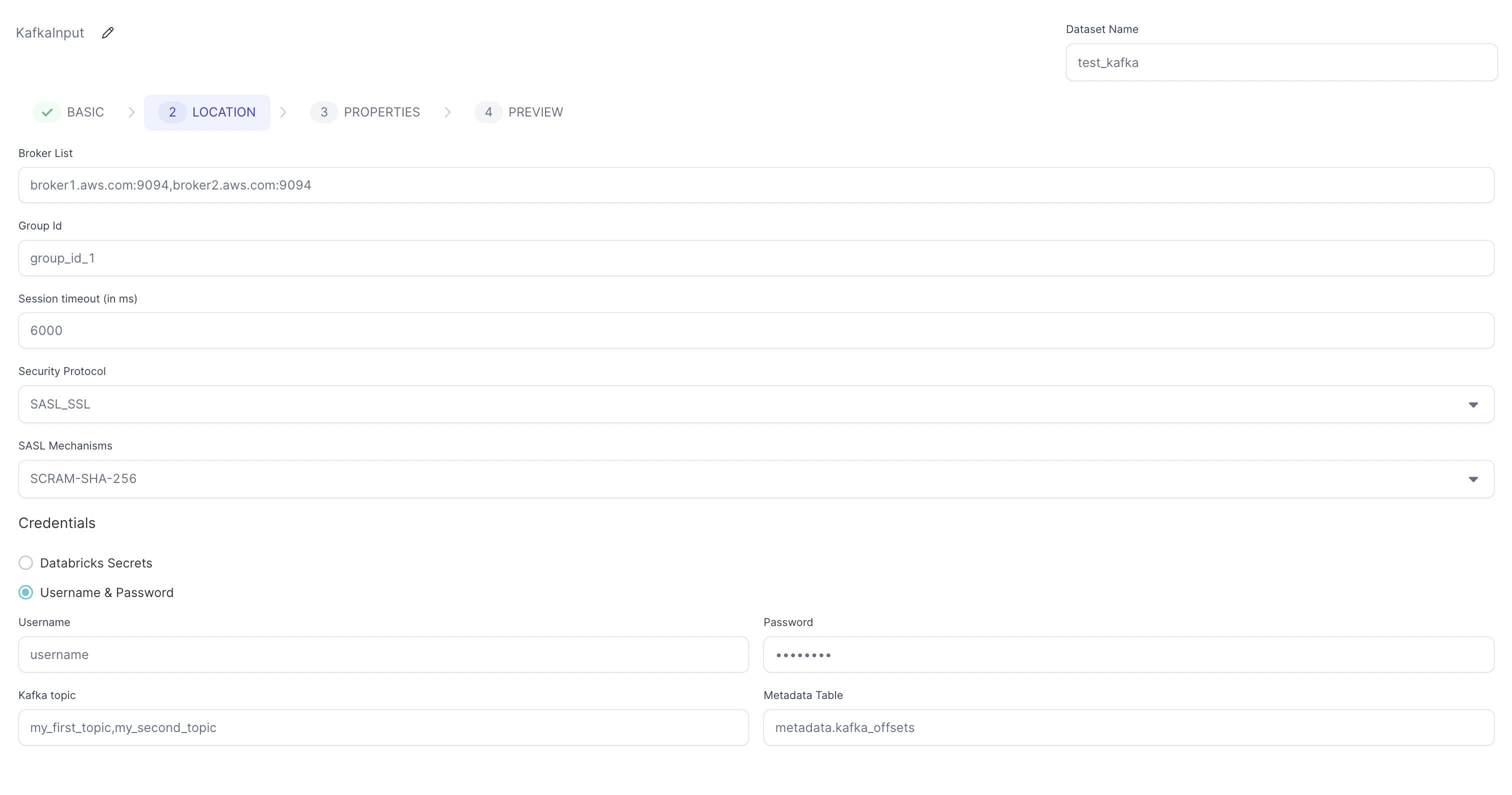
The Source gem reads data from Kafka stream in batch mode and allows you to optionally specify the following additional properties. This means that Kafka only reads data incrementally from the last offset stored in the specified Metadata table. If the Metadata table is not present, then Kafka reads data from the `earliest` offset.
### Source location
| Parameter | Description |
| ----------------------------------------------- | -------------------------------------------------------------------------------------------------------------------------------- |
| Bootstrap Server/Broker List | Comma separated list of Kafka brokers. |
| Group Id (Optional) | Kafka consumer group ID. Used to identify the consumer group for offset management. |
| Session timeout (in ms) | Session timeout for Kafka consumer. Default: `6000` |
| Security Protocol | Security protocol for Kafka. Default value is `NO_AUTH`. |
| SASL Mechanisms | SASL Mechanism for authentication. Default value is `NO_AUTH`. |
| Credentials | How to provide your credentials. You can select: `Databricks Secrets`, `Username & Password`, `Environment variables`, or `None` |
| Kafka topic | Comma separated list of Kafka topics. |
| Store offsets read per partition in Delta table | Whether to store offsets read per partition in Delta table. Default: false |
| Metadata Table | Delta table to store offsets for each topic and partition. |
| Use SSL Trust Store | Enable SSL trust store configuration. |
| Trust Store Location | Path to the SSL trust store file. Required when SSL Trust Store is enabled. |
| Trust Store Password | Password for the SSL trust store file. Required when SSL Trust Store is enabled. |
### Source properties
| Property name | Description | Default |
| ------------------------------------ | ---------------------------------------------- | ------- |
| Kerberos service name for Kafka SASL | Name of your Kerberos service to use in Kafka. | None |
### Example
 ### Compiled code
To see the compiled code of your project, [switch to the Code
view](/data-engineering/development/pipelines/pipelines#project-editor) in the project header.
```python example.py theme={null}
def KafkaSource(spark: SparkSession) -> DataFrame:
from delta.tables import DeltaTable
if spark.catalog._jcatalog.tableExists(f"metadata.kafka_offsets"):
offset_dict = {}
for row in DeltaTable.forName(spark, f"metadata.kafka_offsets").toDF().collect():
if row["topic"] in offset_dict.keys():
offset_dict[row["topic"]].update({row["partition"] : row["max_offset"] + 1})
else:
offset_dict[row["topic"]] = {row["partition"] : row["max_offset"] + 1}
return (spark.read\
.format("kafka")\
.options(
**{
"kafka.security.protocol": "NO_AUTH",
"kafka.sasl.mechanism": "NO_AUTH",
"kafka.bootstrap.servers": "broker1.aws.com:9094,broker2.aws.com:9094",
"kafka.session.timeout.ms": "6000",
"group.id": "group_id_1",
"subscribe": "my_first_topic,my_second_topic",
"startingOffsets": json.dumps(offset_dict),
"kafka.ssl.truststore.location": "dbfs:/Volumes/tmp/kafka.client.truststore.jks",
"kafka.ssl.truststore.password": "password",
}
)\
.load()\
.withColumn("value", col("value").cast("string"))\
.withColumn("key", col("key").cast("string")))
else:
return (spark.read\
.format("kafka")\
.options(
**{
"kafka.security.protocol": "NO_AUTH",
"kafka.sasl.mechanism": "NO_AUTH",
"kafka.bootstrap.servers": "broker1.aws.com:9094,broker2.aws.com:9094",
"kafka.session.timeout.ms": "6000",
"group.id": "group_id_1",
"subscribe": "my_first_topic,my_second_topic",
"kafka.ssl.truststore.location": "dbfs:/Volumes/tmp/kafka.client.truststore.jks",
"kafka.ssl.truststore.password": "password",
}
)\
.load()\
.withColumn("value", col("value").cast("string"))\
.withColumn("key", col("key").cast("string")))
```
***
## Target
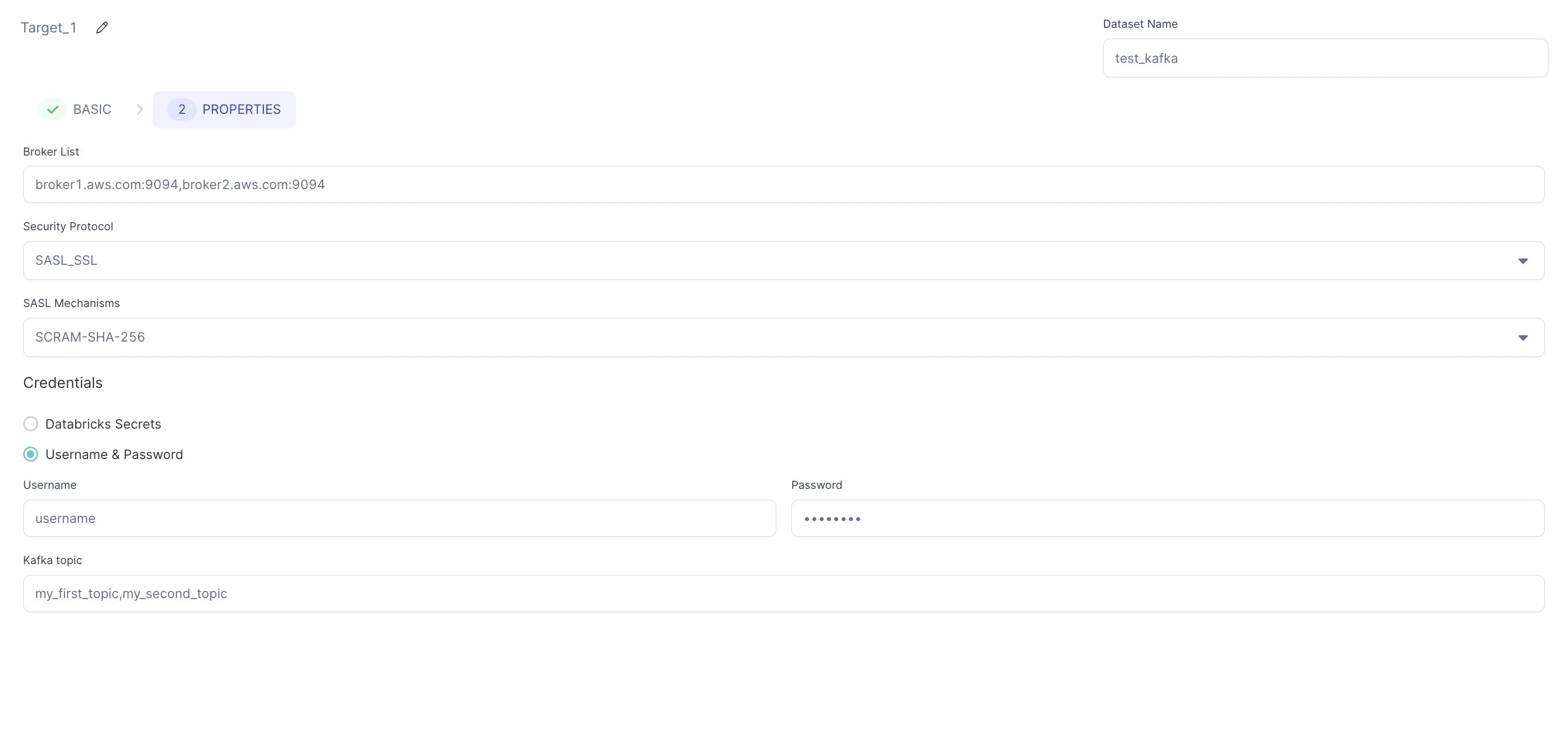
The Target gem writes data to each row from the `Dataframe` to a Kafka topic as JSON messages and allows you to optionally specify the following additional properties.
### Target location
| Parameter | Description |
| ----------------------------- | -------------------------------------------------------------------------------------------------------------------------------- |
| Bootstrap Server/Broker List | Comma separated list of Kafka brokers. |
| Security Protocol | Security protocol for Kafka. Default value is `NO_AUTH`. |
| SASL Mechanisms | SASL Mechanism for authentication. Default value is `NO_AUTH`. |
| Credentials | How to provide your credentials. You can select: `Databricks Secrets`, `Username & Password`, `Environment variables`, or `None` |
| Kafka topic | Comma separated list of Kafka topics. |
| Message Unique Key (Optional) | Key to help determine which partition to write the data to. Used for message partitioning. |
| Use SSL Trust Store | Enable SSL trust store configuration. When enabled, requires Trust Store Location and Trust Store Password. |
| Trust Store Location | Path to the SSL trust store file. Required when SSL Trust Store is enabled. |
| Trust Store Password | Password for the SSL trust store file. Required when SSL Trust Store is enabled. |
### Target properties
| Property name | Description | Default |
| ------------------------------------ | ---------------------------------------------- | ------- |
| Kerberos service name for Kafka SASL | Name of your Kerberos service to use in Kafka. | None |
### Example
### Compiled code
To see the compiled code of your project, [switch to the Code
view](/data-engineering/development/pipelines/pipelines#project-editor) in the project header.
```python example.py theme={null}
def KafkaSource(spark: SparkSession) -> DataFrame:
from delta.tables import DeltaTable
if spark.catalog._jcatalog.tableExists(f"metadata.kafka_offsets"):
offset_dict = {}
for row in DeltaTable.forName(spark, f"metadata.kafka_offsets").toDF().collect():
if row["topic"] in offset_dict.keys():
offset_dict[row["topic"]].update({row["partition"] : row["max_offset"] + 1})
else:
offset_dict[row["topic"]] = {row["partition"] : row["max_offset"] + 1}
return (spark.read\
.format("kafka")\
.options(
**{
"kafka.security.protocol": "NO_AUTH",
"kafka.sasl.mechanism": "NO_AUTH",
"kafka.bootstrap.servers": "broker1.aws.com:9094,broker2.aws.com:9094",
"kafka.session.timeout.ms": "6000",
"group.id": "group_id_1",
"subscribe": "my_first_topic,my_second_topic",
"startingOffsets": json.dumps(offset_dict),
"kafka.ssl.truststore.location": "dbfs:/Volumes/tmp/kafka.client.truststore.jks",
"kafka.ssl.truststore.password": "password",
}
)\
.load()\
.withColumn("value", col("value").cast("string"))\
.withColumn("key", col("key").cast("string")))
else:
return (spark.read\
.format("kafka")\
.options(
**{
"kafka.security.protocol": "NO_AUTH",
"kafka.sasl.mechanism": "NO_AUTH",
"kafka.bootstrap.servers": "broker1.aws.com:9094,broker2.aws.com:9094",
"kafka.session.timeout.ms": "6000",
"group.id": "group_id_1",
"subscribe": "my_first_topic,my_second_topic",
"kafka.ssl.truststore.location": "dbfs:/Volumes/tmp/kafka.client.truststore.jks",
"kafka.ssl.truststore.password": "password",
}
)\
.load()\
.withColumn("value", col("value").cast("string"))\
.withColumn("key", col("key").cast("string")))
```
***
## Target
The Target gem writes data to each row from the `Dataframe` to a Kafka topic as JSON messages and allows you to optionally specify the following additional properties.
### Target location
| Parameter | Description |
| ----------------------------- | -------------------------------------------------------------------------------------------------------------------------------- |
| Bootstrap Server/Broker List | Comma separated list of Kafka brokers. |
| Security Protocol | Security protocol for Kafka. Default value is `NO_AUTH`. |
| SASL Mechanisms | SASL Mechanism for authentication. Default value is `NO_AUTH`. |
| Credentials | How to provide your credentials. You can select: `Databricks Secrets`, `Username & Password`, `Environment variables`, or `None` |
| Kafka topic | Comma separated list of Kafka topics. |
| Message Unique Key (Optional) | Key to help determine which partition to write the data to. Used for message partitioning. |
| Use SSL Trust Store | Enable SSL trust store configuration. When enabled, requires Trust Store Location and Trust Store Password. |
| Trust Store Location | Path to the SSL trust store file. Required when SSL Trust Store is enabled. |
| Trust Store Password | Password for the SSL trust store file. Required when SSL Trust Store is enabled. |
### Target properties
| Property name | Description | Default |
| ------------------------------------ | ---------------------------------------------- | ------- |
| Kerberos service name for Kafka SASL | Name of your Kerberos service to use in Kafka. | None |
### Example
 ### Compiled code
To see the compiled code of your project, [switch to the Code
view](/data-engineering/development/pipelines/pipelines#project-editor) in the project header.
```python example.py theme={null}
def KafkaTarget(spark: SparkSession, in0: DataFrame):
df1 = in0.select(to_json(struct("*")).alias("value"))
df2 = df1.selectExpr("CAST(value AS STRING)")
df2.write\
.format("kafka")\
.options(
**{
"kafka.security.protocol": "NO_AUTH",
"kafka.sasl.mechanism": "NO_AUTH",
"kafka.bootstrap.servers": "broker1.aws.com:9094,broker2.aws.com:9094",
"topic": "my_first_topic,my_second_topic",
"kafka.ssl.truststore.location": "dbfs:/Volumes/tmp/kafka.client.truststore.jks",
"kafka.ssl.truststore.password": "password",
}
)\
.save()
```
***
## Example Pipeline
### Source Pipeline Example
In this example, you read JSON messages from Kafka, parse them, remove any null messages, and persist the data to a Delta table.
### Compiled code
To see the compiled code of your project, [switch to the Code
view](/data-engineering/development/pipelines/pipelines#project-editor) in the project header.
```python example.py theme={null}
def KafkaTarget(spark: SparkSession, in0: DataFrame):
df1 = in0.select(to_json(struct("*")).alias("value"))
df2 = df1.selectExpr("CAST(value AS STRING)")
df2.write\
.format("kafka")\
.options(
**{
"kafka.security.protocol": "NO_AUTH",
"kafka.sasl.mechanism": "NO_AUTH",
"kafka.bootstrap.servers": "broker1.aws.com:9094,broker2.aws.com:9094",
"topic": "my_first_topic,my_second_topic",
"kafka.ssl.truststore.location": "dbfs:/Volumes/tmp/kafka.client.truststore.jks",
"kafka.ssl.truststore.password": "password",
}
)\
.save()
```
***
## Example Pipeline
### Source Pipeline Example
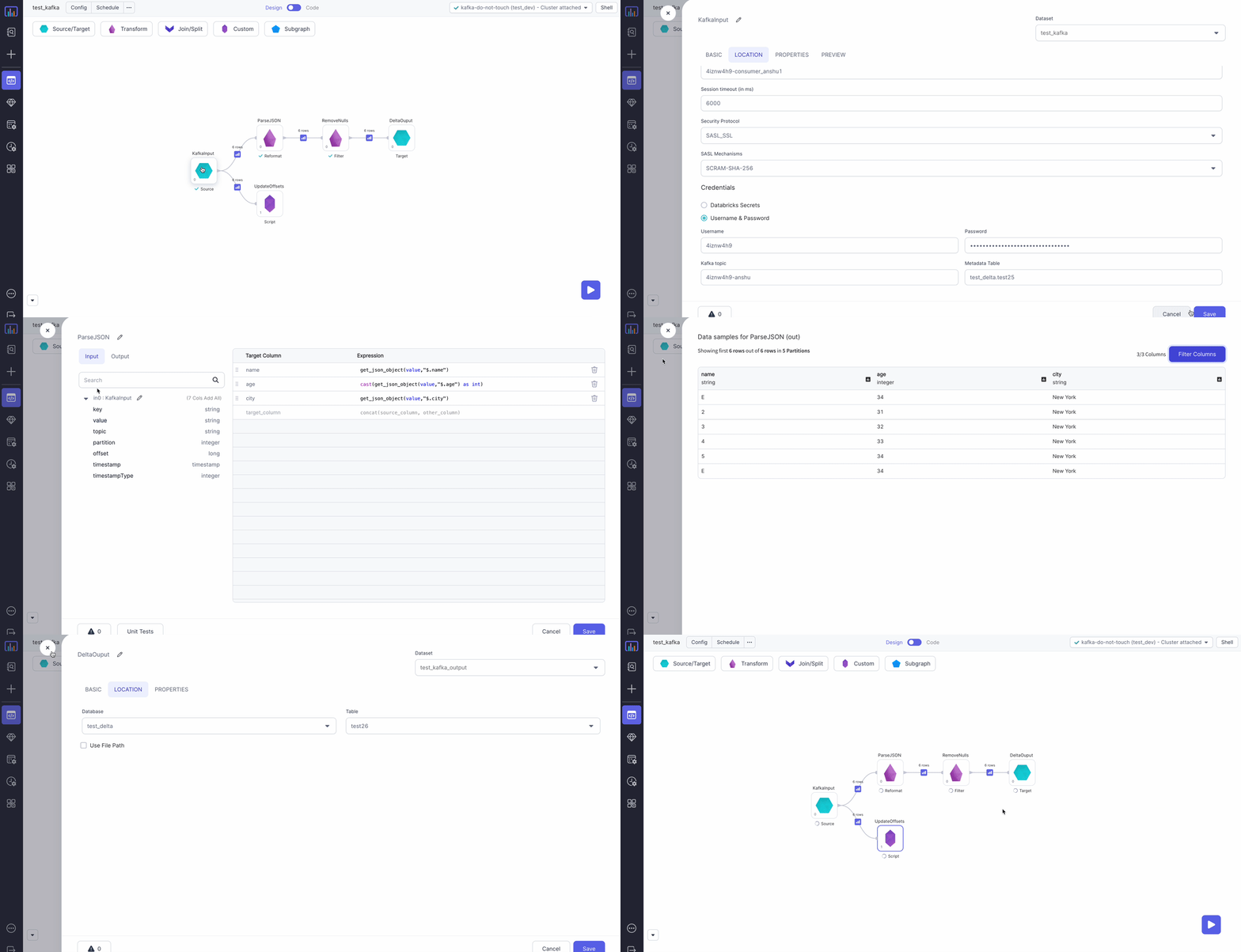
In this example, you read JSON messages from Kafka, parse them, remove any null messages, and persist the data to a Delta table.
 To see the compiled code of your project, [switch to the Code
view](/data-engineering/development/pipelines/pipelines#project-editor) in the project header.
#### Metadata Table
To avoid reprocessing messages on subsequent pipeline runs, update a table with the last processed offsets for each Kafka partition and topic. When you run the pipeline, the table only gets a batch of messages that arrived since the previously-processed offset.
In this example, you update `metadata.kafka_offsets`, which has the following structure:
| topic | partition | max\_offset |
| :---------------- | :-------- | :---------- |
| my\_first\_topic | 0 | 10 |
| my\_first\_topic | 1 | 5 |
| my\_second\_topic | 0 | 10 |
| my\_second\_topic | 1 | 5 |
Taking this approach provides you the with following benefits:
1. Builds the pipeline interactively without committing any offsets.
2. Production workflows only consume messages that arrived since the previously-processed offset.
3. You can replay old messages by modifying the Metadata table.
For production workflows the [phase](/data-engineering/gems/gems#gem-phase) for the `Script` gem that updates
the offsets should be greater than the phase of the Target gem. This ensures that offsets only
update in the table after Prophecy safely persists the data to the Target.
#### Spark Code used for script component
To see the compiled code of your project, [switch to the Code
view](/data-engineering/development/pipelines/pipelines#project-editor) in the project header.
```python example.py theme={null}
def UpdateOffsets(spark: SparkSession, in0: DataFrame):
if not ("SColumnExpression" in locals()):
from delta.tables import DeltaTable
import pyspark.sql.functions as f
metadataTable = "metadata.kafka_offsets"
metaDataDf = in0.groupBy("partition", "topic").agg(f.max(f.col("`offset`").cast("int")).alias("max_offset"))
if not spark.catalog._jcatalog.tableExists(metadataTable):
metaDataDf.write.format("delta").mode("overwrite").saveAsTable(metadataTable)
else:
DeltaTable\
.forName(spark, metadataTable)\
.alias("target")\
.merge(
metaDataDf.alias("source"),
(
(col("source.`partition`") == col("target.`partition`"))
& (col("source.`topic`") == col("target.`topic`"))
)
)\
.whenMatchedUpdateAll()\
.whenNotMatchedInsertAll()\
.execute()
```
To see the compiled code of your project, [switch to the Code
view](/data-engineering/development/pipelines/pipelines#project-editor) in the project header.
#### Metadata Table
To avoid reprocessing messages on subsequent pipeline runs, update a table with the last processed offsets for each Kafka partition and topic. When you run the pipeline, the table only gets a batch of messages that arrived since the previously-processed offset.
In this example, you update `metadata.kafka_offsets`, which has the following structure:
| topic | partition | max\_offset |
| :---------------- | :-------- | :---------- |
| my\_first\_topic | 0 | 10 |
| my\_first\_topic | 1 | 5 |
| my\_second\_topic | 0 | 10 |
| my\_second\_topic | 1 | 5 |
Taking this approach provides you the with following benefits:
1. Builds the pipeline interactively without committing any offsets.
2. Production workflows only consume messages that arrived since the previously-processed offset.
3. You can replay old messages by modifying the Metadata table.
For production workflows the [phase](/data-engineering/gems/gems#gem-phase) for the `Script` gem that updates
the offsets should be greater than the phase of the Target gem. This ensures that offsets only
update in the table after Prophecy safely persists the data to the Target.
#### Spark Code used for script component
To see the compiled code of your project, [switch to the Code
view](/data-engineering/development/pipelines/pipelines#project-editor) in the project header.
```python example.py theme={null}
def UpdateOffsets(spark: SparkSession, in0: DataFrame):
if not ("SColumnExpression" in locals()):
from delta.tables import DeltaTable
import pyspark.sql.functions as f
metadataTable = "metadata.kafka_offsets"
metaDataDf = in0.groupBy("partition", "topic").agg(f.max(f.col("`offset`").cast("int")).alias("max_offset"))
if not spark.catalog._jcatalog.tableExists(metadataTable):
metaDataDf.write.format("delta").mode("overwrite").saveAsTable(metadataTable)
else:
DeltaTable\
.forName(spark, metadataTable)\
.alias("target")\
.merge(
metaDataDf.alias("source"),
(
(col("source.`partition`") == col("target.`partition`"))
& (col("source.`topic`") == col("target.`topic`"))
)
)\
.whenMatchedUpdateAll()\
.whenNotMatchedInsertAll()\
.execute()
```