

Dependencies & cluster requirements
Dependencies & cluster requirements
Dependencies:
- ProphecySparkAlteryxPython 0.0.1+
- UC dedicated clusters 14.3+ supported
- UC standard clusters 14.3+ supported
- Livy clusters not supported
Input
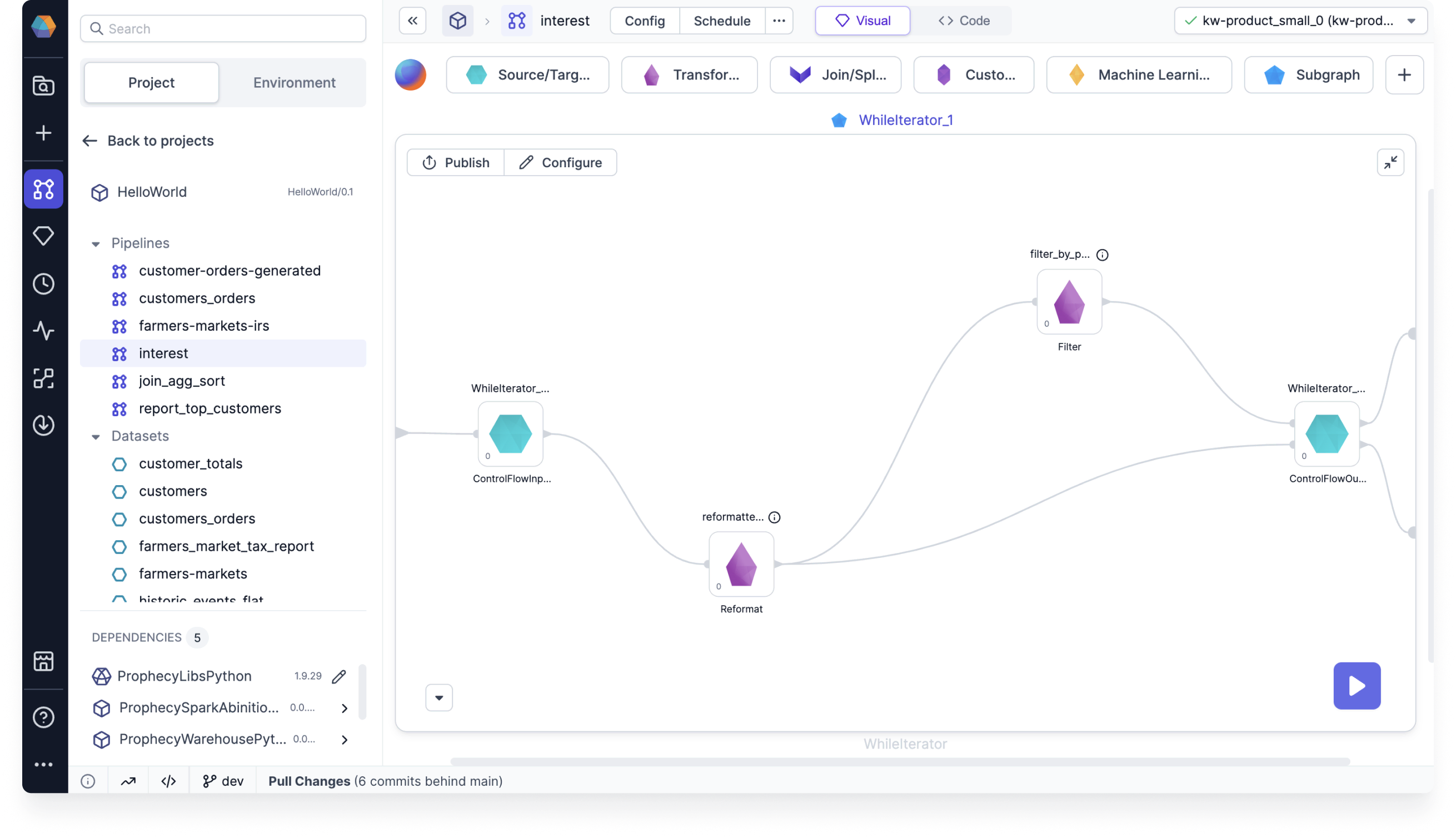
The input of the WhileIterator can be any dataset. Importantly, the output schema of the WhileIterator must match or be a subset of the input schema. This is because the output feeds back into the input as the subgraph is iterating (looping).Configuration
Before setting the WhileIterator configuration, make sure you are familiar with pipeline
configurations.
Subgraph
Within the WhileIterator, you can design a flow with multiple gems to create your desired output. Importantly, you also need to understand the two inputs of the WhileIterator_Output. The order of your inputs is important:- The in0 dataset contains the DataFrame for the following iteration. If this dataset becomes empty, the loop is terminated.
- The in1 dataset passes on an individual iteration. You’ll see the entire list of iterations as the output of the WhileIterator gem.
Break condition
There are two scenarios in which the WhileIterator will break:- The in0 dataset of the WhileIterator_Output becomes empty.
- The maximum number of iterations is reached.
Output
There are two outputs of the WhileIterator:- The out0 dataset that contains the output of the last iteration of the WhileIterator.
- The out1 dataset that contains the whole list of iterations produced by the WhileIterator. This is produced by performing a union on all output iterations.
Example
Imagine you are simulating an investment that earns a fixed percentage of interest per year. You want to keep compounding the interest until your investment reaches a desired amount. You can use the WhileIterator gem to produce a dataset demonstrating this yearly growth.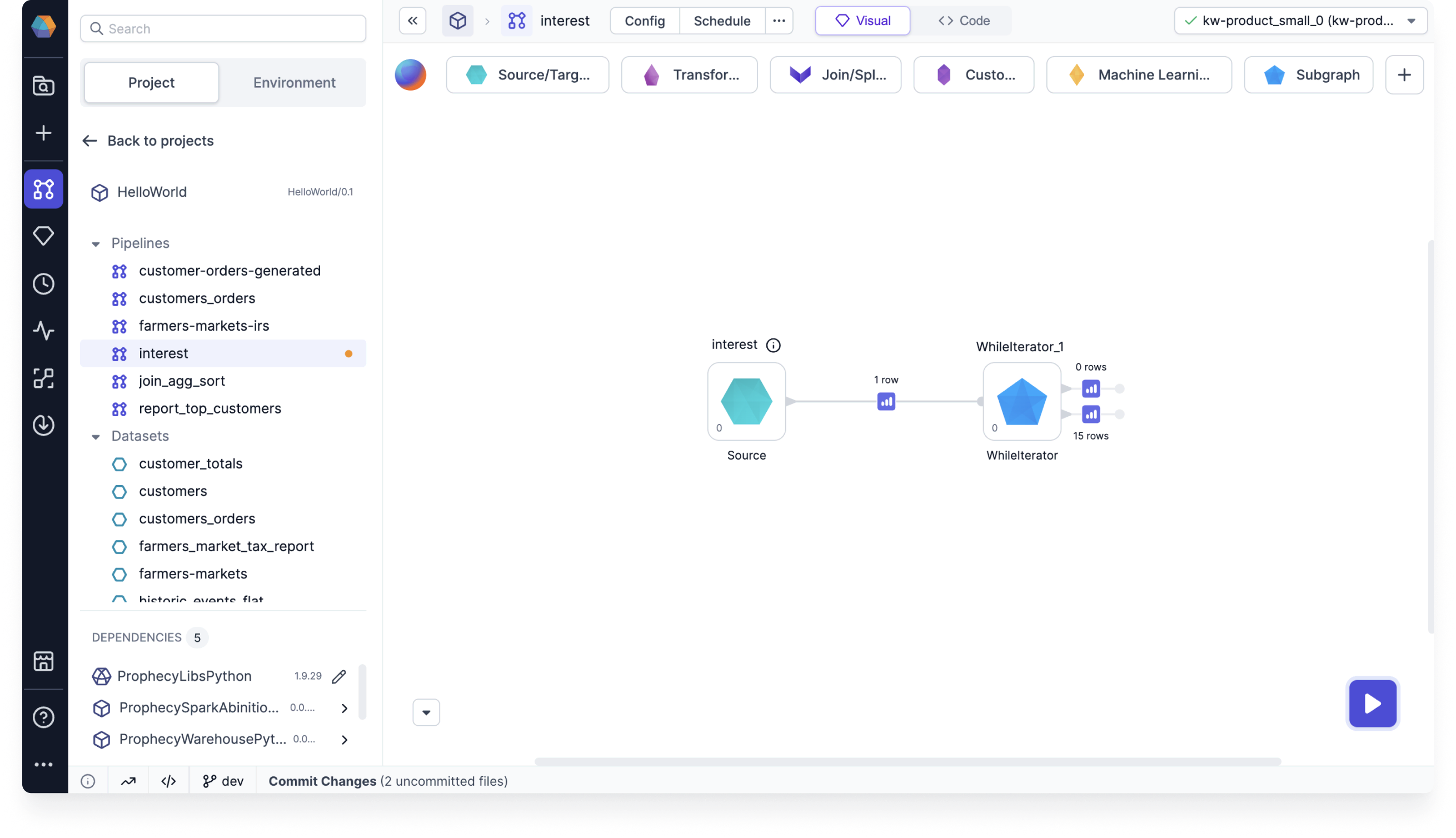
Add Reformat gem
Now, let’s use a Reformat gem in the WhileIterator subgraph to update the Year and Principal each iteration.- Add the Reformat gem inside the WhileIterator.
- Connect WhileIterator_Input to the Reformat gem.
- Connect the Reformat gem to the WhileIterator_Output.
- Configure the Expressions table as it is shown below.
Terminate loop
The while loop will stop if the in0 dataset becomes empty. How can the in0 dataset become empty? In this example:- Add a Filter gem with the condition
principal < 2000. - Connect the Reformat gem output to the input of the Filter gem.
- Connect the Filter gem output to the input of WhileIterator_Output.
View output data
The out0 dataset should be empty because we used a Filter gem to return an empty set when theprincipal > 2000.
Below is an example out1 dataset. This lets you project how your principal will grow over the years.