

- Enter runtime values through forms and interactive inputs.
- Run pipelines without editing pipeline logic.
- Review results in charts and tables.
- Save reusable configurations.
- Schedule recurring executions.
- Share operational workflows with other teams.
Open an analysis
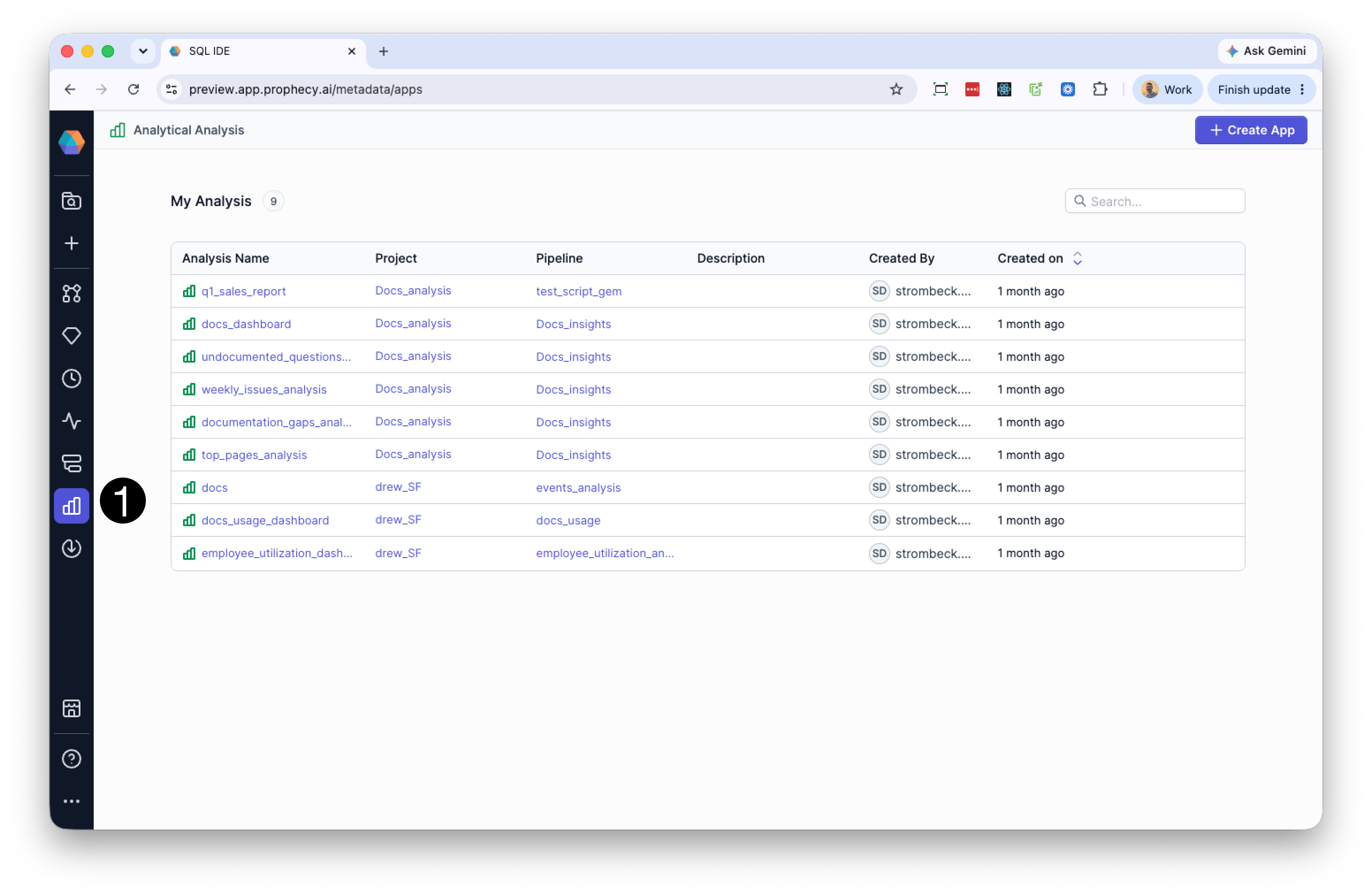
- Open the Analysis Browser (the graph icon) in the left sidebar.
- Select an analysis.
Understanding configurations
Analyses support multiple configurations. A configuration is a named set of runtime values for an analysis. Configurations allow teams to create reusable presets for different workflows, environments, or operational scenarios. For example, an analysis might include:- A
productionconfiguration - A
stagingconfiguration - Configurations for different regions or business units
Create a configuration
- In the Analysis Browser, hover over an analysis.
- Click the + icon.
- Enter a configuration name.
- Click Create.
Manage configurations
To manage a configuration:- Open the configuration menu.
- Select an action:
- Rename
- Delete
Run an analysis
When you run an analysis, Prophecy executes the underlying pipeline using the current configuration values. Analysis results render in charts, tables, and other visualization components.- Open a configuration.
- Enter or update runtime values.
- Click Run.
- Review the results.
- Enter
Westin a Region field - Run the analysis
- Review a chart showing sales by product category for the western region
Refresh analysis results
Analyses can become out of date if the underlying pipeline changes. If the pipeline definition changes after the analysis was last executed, Prophecy displays a warning indicating that the analysis should be rerun. To refresh the analysis:- Open the configuration.
- Click Run.
Schedule an analysis
You can schedule configurations to run automatically. Schedules are attached to individual configurations, allowing the same analysis to run with different runtime values on different schedules. For example:- A
productionconfiguration might run hourly - A
stagingconfiguration might run once per day
- Open a configuration.
- Click Schedule.
- Configure:
- Cron expression
- Time zone
- Notification settings
- Save the schedule.
Share analyses
You can share published analyses with other teams for interactive consumption and execution. Access to analyses is controlled by Prophecy’s team-based permission model. If your team owns a project, you can:- Create analyses
- Edit analyses
- Delete analyses
- Manage configurations
- Run analyses
- Use existing configurations
- Review results
To learn more, see team-based access.