

- Release: Create a versioned project release.
- Deployment: Deploy that release to one or more fabrics.
Publication controls
The publication controls in the SQL IDE change based on the current project state.Button labels
When publication controls do not appear
When publication controls do not appear
Prophecy hides publication controls when:
- The project is a template or example project
- The project is in shared project mode
- The project is in replay mode
- The project is in historical mode
- Simple Version Control is not enabled for the project
Disabled publication states
Disabled publication states
Under certain conditions, publication controls are disabled.
Save draft changes
If your project contains unsaved changes, the publication control displays Save to Draft. To save draft changes:- Click Save to Draft.
- Review the draft changes.
- Save the draft.
Publish and deploy a project
After you save your latest draft changes, the publication control displays Publish. To publish a project version:- Click Publish.
- Review the version details.
- Review the changes included in the version.
- Enter or edit the version number.
- Add a version description.
- Optional: Select one or more fabrics for deployment.
- Optional: Select a project parameter set.
- Click Publish.
If any pipelines are marked as draft, their in-progress changes aren’t included in this version — they ship unchanged (or are left out entirely, if never published before). The changes list shows them with a Draft - Held label, along with any business apps built on them, and a summary line reports how many pipelines were held back. To include a pipeline’s latest changes in this publish, remove its draft status first. See Draft pipelines.
You can only deploy to fabrics your team can access.
Fabric access and permissions
Fabric access and permissions
To deploy a project to a fabric, your team must have access to that fabric.For example:
- Development fabrics may allow broader access for testing and iteration
- Production fabrics may restrict deployment access to approved users
- Builds the project in the selected fabric.
- Applies the selected project parameter set.
- Creates or updates the deployment for that environment.
Publication validation errors
Publication validation errors
Prophecy validates the project before publication.
Publication logs
Publication logs
Prophecy generates logs for each publication step. If deployment fails, publication logs show the exact step where the process stopped.The logs help you troubleshoot failed publications and identify where publication stopped.The publication process includes these steps: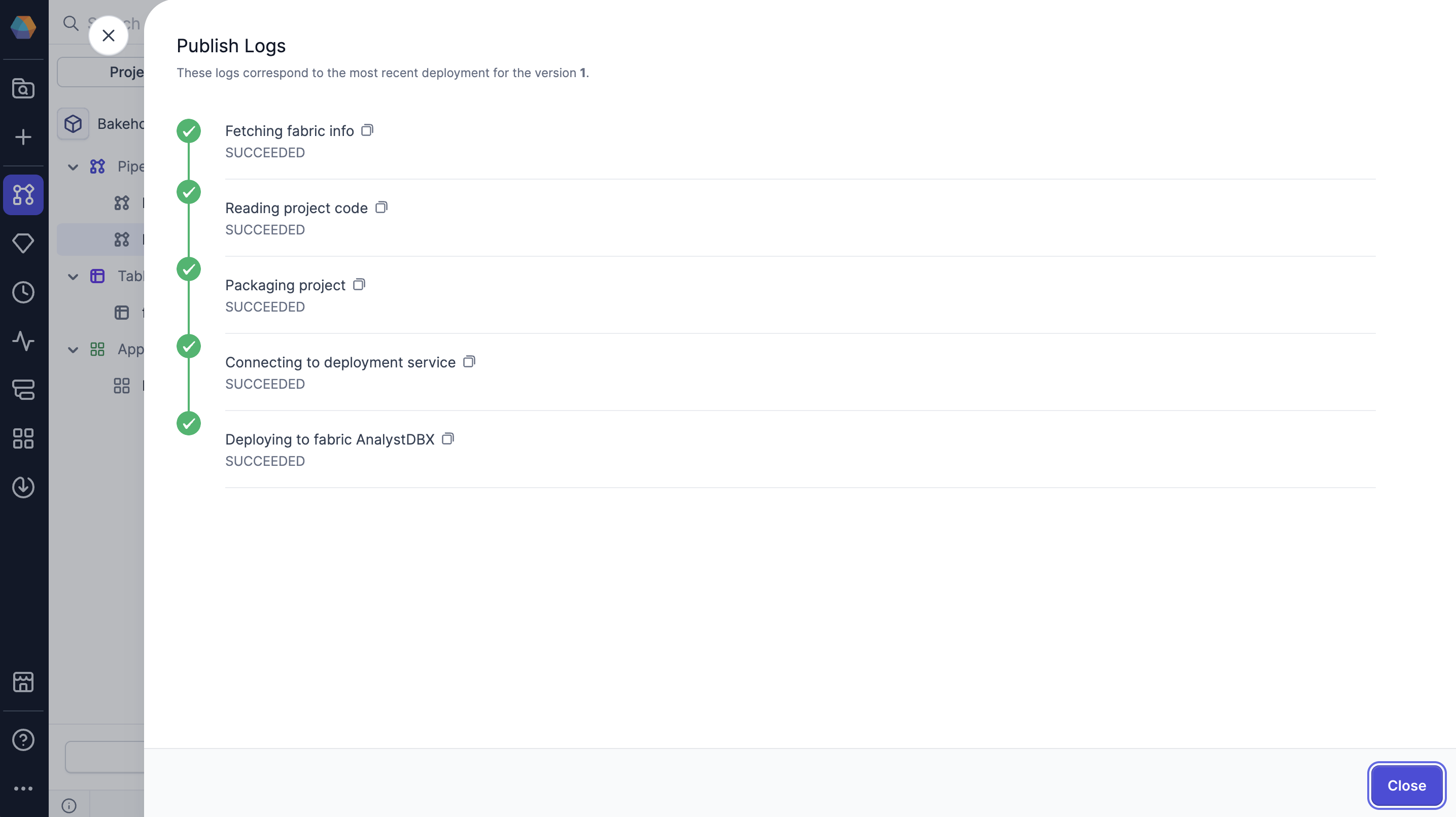
- Fetching fabric info: Retrieve information about the selected fabric
- Reading project code: Review project code elements
- Packaging project: Bundle project components together
- Connecting to deployment service: Connect to the deployment service
- Deploying to fabric: Deploy the project to the selected fabric
Request to publish
Prophecy allows multiple users to work on the same project simultaneously. In collaborative projects, publishing often requires coordination with other users. If another user currently holds a peer lock on the project, Prophecy opens a Request to Publish dialog instead of publishing immediately. Collaborators can review, approve, or reject the publication request before the new version is released.Share a project

Available for Free and Professional Editions
only.
- Existing Prophecy users.
- External users who are not yet registered with Prophecy.
- review the project,
- interact with Agent in limited mode,
- and sign up for Prophecy.
- Click the arrow next to Save to Draft or Publish.
- Select Share project.
- Share the project by:
- entering an email address,
- or copying the share link.
Guest users can ask a limited number of Agent questions in shared projects. Guest Agent chats are not persisted and disappear after the browser refreshes.