

adhoc-strats skill turns a plain-language question like “show me top 10 vehicle models by balance” into a full stratification query, without you having to build the aggregation yourself.
You can ask the Agent what’s available:
Built-in skills
These skills work across all supported Auto ABS deal types (GMCAR, SDART, BMWOT, TAOT, CALT, EART, and so on) and integrate with the harmonization and strats pipelines you’re already using. Skills are customizable to your organization’s needs.
When you confirm use of a skill, the Agent identifies the necessary steps and gems, executes them, and returns traceable results — for example, surfacing state or vintage-quarter concentrations to support a pool-cutting decision.
Get the full cheat sheet for a skill
You can ask the Agent for all cheat sheet prompts: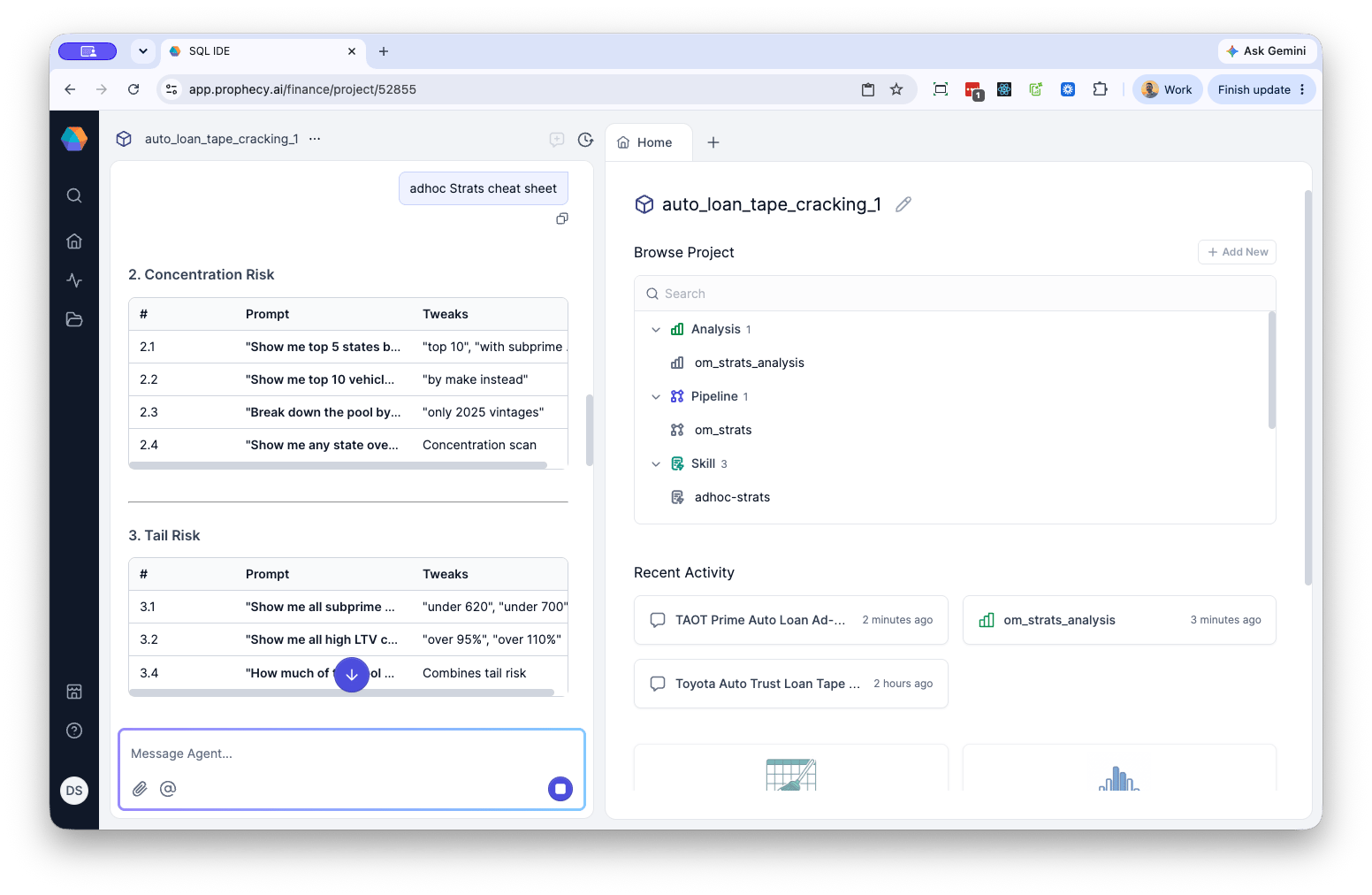
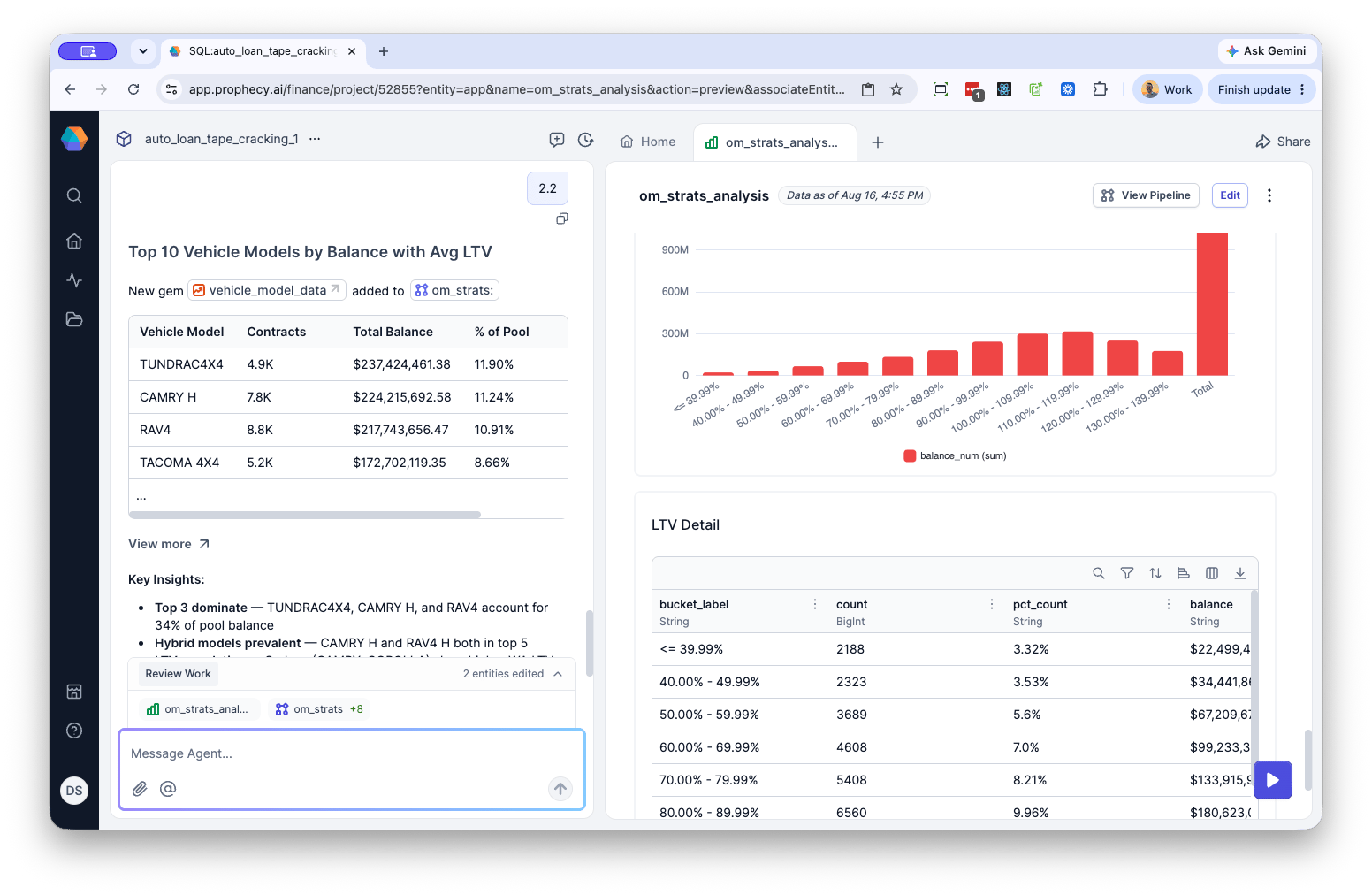
run 2.2.
Running 2.2 Show me top 10 vehicle models by balance with avg LTV, for example yields a result similar to the following:
Ad-hoc stratification (adhoc-strats)
The adhoc-strats skill accepts natural-language prompts for exploring a loan pool. Prompts are organized around common analysis patterns:
- Pool Health — summary stats (contracts, balance, WA FICO/LTV/APR), credit tier splits, new/used breakdowns
- Concentration Risk — top states, vehicle models, and vintages by balance; concentration threshold flags
- Tail Risk — filtering to subprime FICO, high LTV, or combined tail segments
- Stacked Risk — multi-factor filters (e.g., FICO under a threshold AND LTV over a threshold)
- Pricing Adequacy — APR by credit tier, mispriced-risk detection, new vs. used APR spread
- Delinquency & Performance — DPD bucket breakdowns, delinquency by state or credit tier
Cross-deal comparison (asset-comp)
The asset-comp skill runs on any of these trigger phrases:
asset comp/add to comp/compare to other dealscompare this tape/extract comp/insights on this dealwrite research note/collateral analysis/cross-deal comparisonGMCAR comp/download prospectus/refresh comp
Operations
Input modes
- Harmonized CDM tape — uses your current pipeline’s
output_previewdata - SEC prospectus — downloads and parses prospectus PDFs (e.g., “download prospectus for GMCAR 2025-2”)
Example: extracting a comp
“extract comp from this tape” returns a preview — no changes are made to the comp table until you confirm:SDART 2025-4 — Comp Extraction (Preview)
Next steps from a preview:
- “add to comp” → insert into
cross_deal_comp.csv - “compare to others” → side-by-side with peer deals
- “insights on this deal” → full cross-deal analysis
Add a new skill
Built-in skills cover common workflows — harmonization, ad-hoc strats, cross-deal comparison — but you can add a skill scoped to your own team’s practices. For example, a desk might codify its own tail-risk definitions as a skill, since what counts as “subprime” or “high LTV” varies by deal type. A skill such asdesk-risk-thresholds could encode your team’s specific cutoffs and stress-test segments as a reusable prompt set, so anyone on the desk gets consistent results without re-specifying thresholds each time.
To add a new skill:
- Click the +, then select New Tab, then select Skill.
- In the dialog, enter a Skill Name and click Create.
- On the new page, enter a description and content for the skill.